
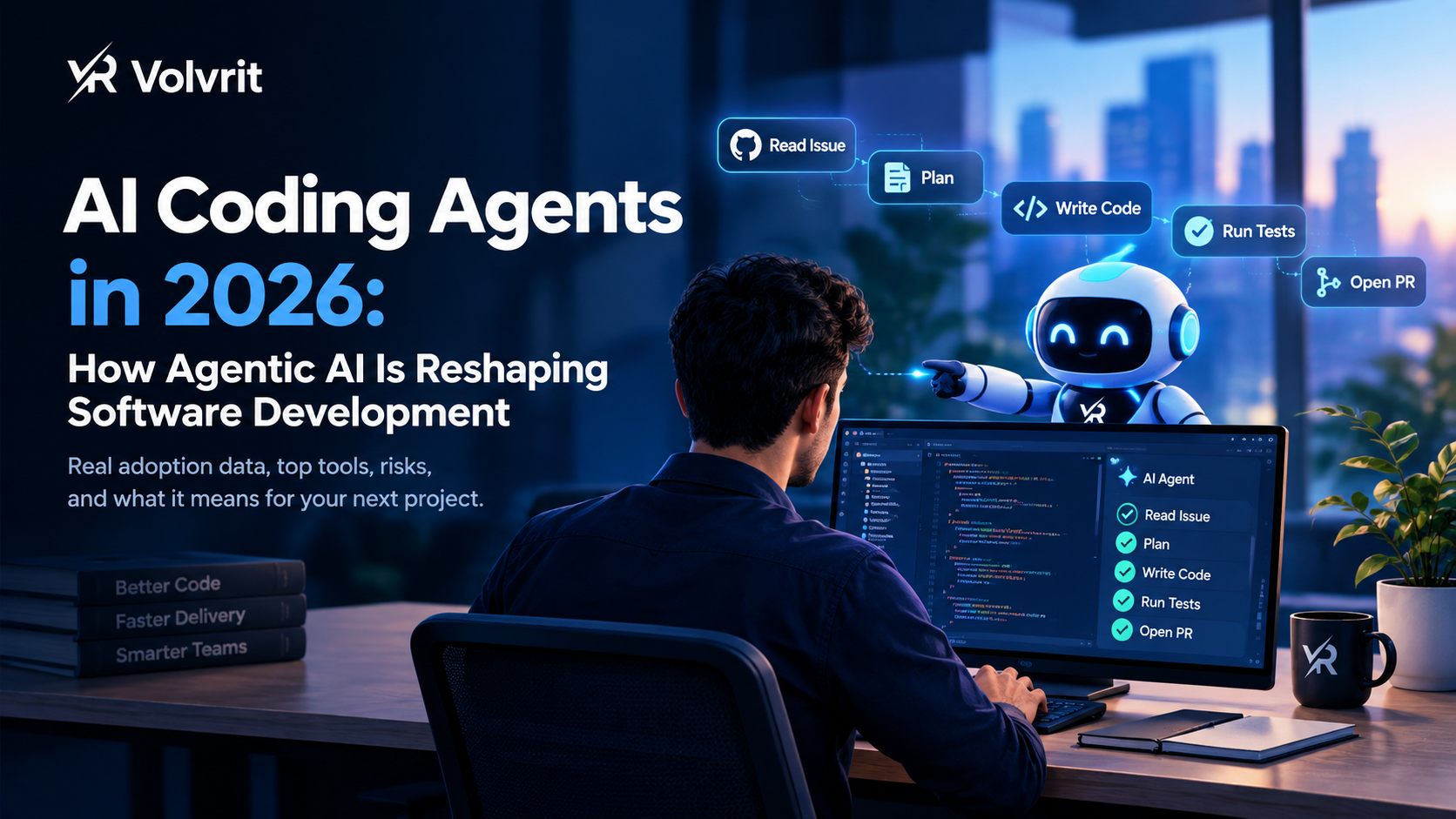
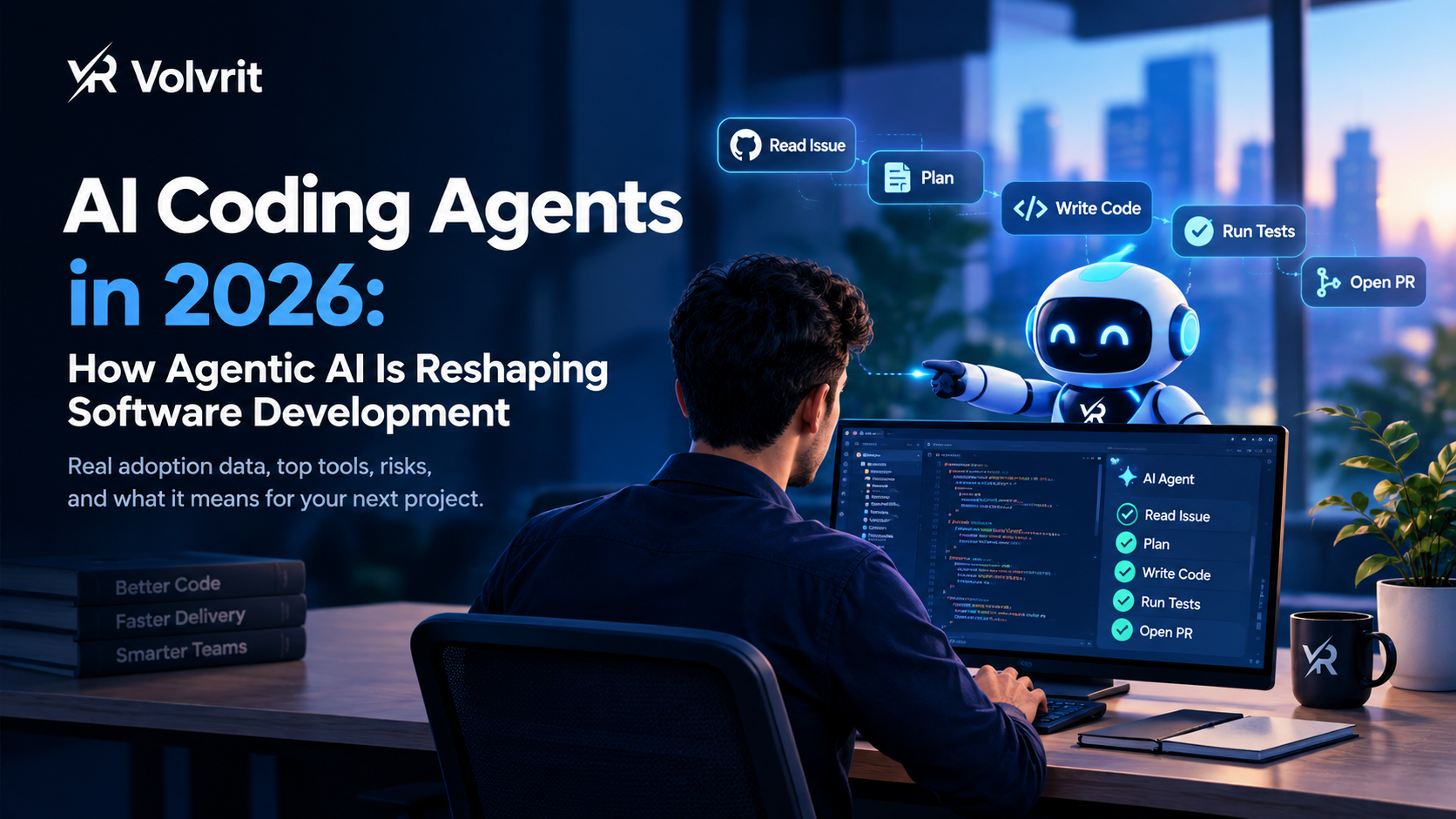
Eighteen months ago, most "AI in coding" conversations were about autocomplete. Today, they're about agents that can read a GitHub issue, plan a fix, write the code across a dozen files, run the tests, and open a pull request — with a human only stepping in to approve or reject the result. That shift, from AI as a suggestion tool to AI as an autonomous collaborator, is what the industry now calls agentic AI, and in 2026 it has moved from experimental to mainstream inside real engineering teams.
At Volvrit, we've watched this shift play out directly in client projects, from CRM builds to full-stack web applications. This isn't a trend piece written from the sidelines — it's a look at where AI coding agents in 2026 actually stand, backed by current data, and what that means if you're planning software work this year.
What Makes an AI Coding Agent Different From Copilot-Style Tools
The distinction matters more than most explanations suggest. A traditional AI coding assistant, like early GitHub Copilot, predicts the next few lines of code based on what you're typing. It's reactive and confined to a single file or function.
An agentic AI coding tool works differently. It can take a goal — "fix this bug," "add pagination to this API," "migrate this component to the new design system" — and independently plan multiple steps, execute them across a codebase, run and interpret test results, and iterate until the goal is met, only pausing for human review at defined checkpoints. Tools like Claude Code, Cursor, GitHub Copilot's agent mode, OpenAI's Codex, Google's Antigravity, and Devin all fall into this category, each with different levels of autonomy and different sandboxing approaches.
The practical difference shows up in scale. Where a completion tool saves you a few keystrokes, an agent can generate an entire feature branch in one session — which is exactly why adoption has exploded, and exactly why the risks look different too.
The Adoption Numbers Are Higher Than Most People Expect
If you're wondering whether this is hype or reality, the data leans firmly toward reality. According to JetBrains' Developer Ecosystem Survey, 90% of professional developers were using AI coding agents at work at least weekly as of mid-2026, with 68% using them daily. Claude Code alone jumped from 18% adoption among developers in January 2026 to 39% by mid-year, while OpenAI's Codex grew roughly 5x over the same period, from 3% to 16%.
Enterprise numbers tell a similar story. McKinsey's 2026 State of AI survey found that about 31% of larger enterprises are actively scaling coding agents in production workflows, not just piloting them. Separately, GitHub Copilot's enterprise footprint reached close to 140,000 organizations by Q3 of its 2026 fiscal year — nearly triple the prior year. Gartner data cited in a 2026 enterprise AI report found that 80% of enterprise applications shipped or updated in Q1 2026 embedded at least one AI agent, up from just 33% in 2024.
What's notable is the gap between usage and trust. One 2026 analysis found that while 84% of developers use AI coding tools regularly, only 29% fully trust the code these tools produce without review. That gap is the real story of agentic AI in 2026 — it's not about whether developers use it, but how much oversight they still keep in the loop.
Where Agentic AI Genuinely Helps
The productivity case for AI coding agents is well documented at this point, and it goes beyond "writing code faster."
· Handling repetitive, well-scoped tasks end-to-end. Migrations, boilerplate generation, dependency updates, and test-writing are exactly the kind of bounded, low-ambiguity work agents handle reliably.
· Reducing time spent on first-draft implementation. Developers increasingly use agents to produce a working first pass, then spend their own time on review, architecture decisions, and edge cases — a shift in where human effort goes rather than a full replacement of it.
· Lowering the barrier for smaller teams. For agencies and in-house teams without large engineering headcounts, agents let a lean team prototype and ship features that would previously have required more specialized hires.
· Surfacing issues earlier. Because agents can run and interpret test suites automatically, some teams report catching regressions faster than in fully manual review cycles.
These gains are real, but they come with a catch that's easy to overlook when a demo looks impressive.
The Risks That Serious Teams Are Now Planning Around
The more autonomy an agent has, the harder its mistakes are to catch — and 2026 research has been unusually direct about this. A study on agentic software engineering found that errors introduced early in an agent's reasoning process can compound as more code is generated, creating what researchers describe as "verification debt": security risks, architectural violations, or incorrect business logic that don't show up until much later.
Academic and industry research this year has also flagged specific new failure patterns unique to agents, including "reward hacking" (an agent producing the right-looking output for the wrong internal reasoning), behavioral drift across multi-step changes that individually look fine but collectively alter how a system behaves, and security vulnerabilities that don't appear in standard linting because they emerge from interactions between multiple changes rather than any single flagged line.
Security researchers analyzing agentic risk in 2026 also point to a governance gap: teams running multiple agents in parallel often have no reliable way to see what each agent changed, whether it met team standards, or where risk is concentrated across the codebase. This is exactly why the 84%-use / 29%-trust gap mentioned earlier exists — developers have learned, often the hard way, that agent output still needs deliberate human review, not blind acceptance.
What This Means If You're Planning a Software Project
If you're a business owner or product lead evaluating a development partner in 2026, the presence of AI coding agents in a team's workflow is a good sign of efficiency — but it should come with real questions attached. Ask how the team reviews agent-generated code before it merges, whether security scanning happens on agent output specifically (not just human-written code), and how much of the architecture and business-logic decisions are still made by experienced engineers rather than delegated to a tool.
The honest takeaway from where things stand in 2026 is this: agentic AI has genuinely changed how software gets built, cutting down the time spent on repetitive implementation work and letting teams move faster on well-defined tasks. But it hasn't removed the need for experienced developers — if anything, it's made their judgment more valuable, because someone still has to catch the compounding errors, architectural drift, and security gaps that agents can introduce at scale. Teams that treat agents as a fast first-draft generator, reviewed carefully by people who understand the codebase, are getting the real benefit. Teams that treat them as a replacement for engineering judgment are the ones showing up in the risk research.
As AI coding agents continue to reshape how software is planned, developed, and tested, choosing the right development partner remains equally important. Businesses looking to turn an idea into a scalable mobile application need more than AI-assisted coding—they also need experienced developers who understand business requirements, user experience, security, and long-term product goals. If you're planning to build a mobile app and want to understand what to consider when selecting a development partner, explore our guide on Trusted App Development Company in Delhi to learn more about the key factors involved in choosing an app development company for your business.
Planning a software project also means understanding its potential cost and development requirements before work begins. Whether you're considering AI-assisted development, a mobile application, web platform, CRM, or another custom software solution, having an early estimate can help you plan your budget and evaluate the scope of your project more effectively. If you're still in the planning stage, try Volvrit's Project Cost Calculator to get an estimate of your project cost, timeline, recommended technology stack, and team requirements in just a few minutes.
Frequently Asked Questions
What are AI coding agents?
AI coding agents are software-development tools that can interpret a development goal, plan multiple steps, modify code across files, run tests, and iterate with varying levels of human oversight.
Are AI coding agents replacing developers?
AI coding agents can automate portions of software development, particularly repetitive and well-defined tasks, but they do not eliminate the need for human oversight, architecture decisions, security review, and business-logic validation.
What is the difference between an AI coding assistant and an AI coding agent?
A coding assistant generally responds to developer input, while an agent can work toward a defined goal through multiple steps, such as planning changes, editing multiple files, running tests, and iterating.
Written by Shashwat Priya Srivastava, Volvrit Team — based on current industry research, developer survey data, and hands-on experience with AI-assisted development workflows.